
Exercise bikes after knee or hip surgery
Following knee or hip surgery, exercise is essential for recovery. An exercise bike can play a crucial role in this process, either as an addition to physiotherapy or for independent exercise in the comfort of your own home.

Training on an exercise bike or ergometer is generally considered a gentle, low-impact form of exercise, which is frequently used as part of rehabilitation following knee and hip surgery. The German Society for Sports Medicine and Prevention provides some general guidance:
<"After a rest period of 3 to 6 months following the surgery, you can start taking part in low-impact sports." (https://www.dgsp.de/seite/376544, Stand: 07.07.25)
Compared with hip replacements, knee replacements usually mean that a gentler start to exercise training is recommended. If you were already cycling regularly or using an exercise bike before surgery, you will be able to start training more quickly.
However, it is also important to bear in mind that each patient’s starting point for exercise is unique. Factors to consider include the type of prosthesis used, any underlying medical conditions and which joint has undergone surgery. You should therefore check with your orthopaedist or physiotherapist whether sessions on an exercise bike or ergometer are suitable for you, and how quickly and intensely you should begin your training.
In this article, we will answer general questions about using exercise bikes and ergometers following knee or hip surgery. We will provide a step-by-step explanation of what you should bear in mind, which models are suitable and how you can start exercising in a way that is safe for your joints.
Why is exercise so important after surgery?

Following a total knee replacement (TKR) or total hip replacement (THR), as well as other orthopaedic procedures, targeted exercise is crucial for restoring joint function. Gentle activity can help to:
- stabilise and strengthen the muscles around the operated joint
- improve mobility and coordination
- maintain general fitness and stamina
- reduce pain by improving blood circulation
- build confidence in your mobility and ability to exercise
An exercise bike provides the ideal training conditions, regardless of the weather. You don't need to go anywhere, and you can exercise in the comfort of your own home. Most importantly, a stationary bike is much safer than a regular bike, which requires you to balance and manoeuvre through traffic.
Exercise bikes or ergometers: Which is better after knee or hip surgery?
Many people think that the terms 'exercise bike' and 'ergometer' refer to the same type of machine, but there are important differences when it comes to rehabilitation. While the resistance on an exercise bike is manually controlled, the settings on an ergometer are computer-controlled and accurate to the watt. This means that with an ergometer (and also with an recumbent ergometer) it is possible to monitor training more precisely and perform targeted fitness training. Many exercise bikes and ergometers come with hand pulse sensors and the option to connect to a chest strap (for heart rate readings). Overall, ergometers provide more features (e.g. watt-controlled training, heart rate-controlled training, interval training) enabling you to precisely control the intensity of your workout.
Exercise bikes after hip replacement (THR)
Following a total hip replacement (THR), targeted exercise is key to successful rehabilitation. While physical activity was once discouraged, it is now recommended to exercise regularly – for example, for one hour a day. This is due to new medical findings and improvements in surgical techniques and implants. Provided you consult your doctor or physiotherapist first, an exercise bike can be a suitable piece of equipment for improving the mobility of your new hip joint and gently rebuilding your muscles following a hip replacement .
It is important that the exercise bike's range of motion is suitable for your current fitness level. Models with a low step-through are easier to mount and dismount. A high, comfortable seat and individually adjustable pedals (Vario crank arm) help to move the hips in a way that is as gentle on the joints as possible. Ideally, the bike should also allow for a very low resistance setting to encourage an almost passive movement when you first start out.
Exercise bikes after knee replacement (TKR)
Following a total knee replacement (TKR), an exercise bike or ergometer can help to gradually restore mobility, activate the muscles and have a positive effect on the healing process. A key benefit is that it allows you to exercise without having to bear your own body weight, which is particularly important during rehabilitation.

If you have had knee surgery, you should adjust the seat height to suit your body height, ensuring that the angle of your knee is not too sharp when exercising. The seat on ergometers such as the cardiostrong Exercise Bike BX70i is fully adjustable. Many patients find it most comfortable to start by making very small circular movements with minimal force. To reduce the range of motion, we recommend fitting your exercise bike with a Vario crank arm.
TIP: An ergometer featuring adjustable resistance in small increments (e.g. 5 watts) allows for precise adjustments to be made according to your fitness level – which is particularly advantageous for training after knee surgery or if you have osteoarthritis. In addition, induction braking systems ensure a particularly smooth and even motion.
Exercise plan: How to get started after surgery
Here we will show you a simple example of how to start exercising at home after surgery – but only after consulting your doctor. As mentioned, specific exercise recommendations must be decided on a case-by-case basis.
- Weeks 3–4 after the surgery: 5–10 minutes with very light resistance, 1–2 times a day
- Weeks 5-6: 10-15 minutes with maybe slightly higher resistance
- Weeks 7+: 15-30 minutes with a steady, slow increase in training intensity
Important note:
Our content is no substitute for medical advice. Before starting a training programme on an exercise bike or ergometer following knee or hip surgery, you should always consult your doctor or physiotherapist. Only qualified medical professionals can assess when and to what extent exercise is appropriate and safe for you. If in doubt, please only exercise under the guidance of a physiotherapist or under medical supervision. If you experience any discomfort during your workout, stop exercising immediately and seek medical advice.
What to look out for when choosing exercise bikes and ergometers for rehabilitation
Here, we provide a brief overview of the most important and recommended features of exercise bikes and ergometers.
Features that support rehabilitation:
- Low step-through
- Fully adjustable seat
- Smooth, even resistance/motion
- Adjustable crank arms (Vario crank arm)
- Precisely adjustable resistance in watts
- User-friendly console displaying workout metrics
Prescription exercise bike? Is it covered by health insurance?
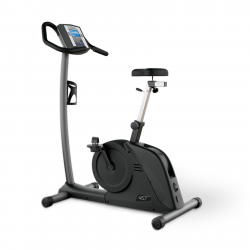
Many people who have undergone knee or hip surgery wonder: 'Can I get an exercise bike through my health insurance?' The answer is yes, under certain conditions. If your doctor deems it medically necessary, they can prescribe an exercise bike or ergometer. In this case, the equipment is classified as a medical aid.
The key points are:
- It has to be an approved medical device bearing the CE mark (such as the ErgoFit Cycle 457 Med)
- The prescription must clearly state the purpose (e.g. mobilisation following joint surgery).
- Approval is decided on a case-by-case basis by the health insurance provider.
Conclusion: Exercise bikes and ergometers for joint-friendly exercise
Following knee or hip surgery, an exercise bike enables you to exercise safely and comfortably at home in a targeted way. Once you have consulted your doctor or physiotherapist, you can adapt your training according to your recovery progress and individual needs.
You are not sure which model is right for you? Our expert team will be happy to provide personalised advice - online, over the phone or in person at one of our stores.
Links
Read on for more interesting information on exercise bikes: